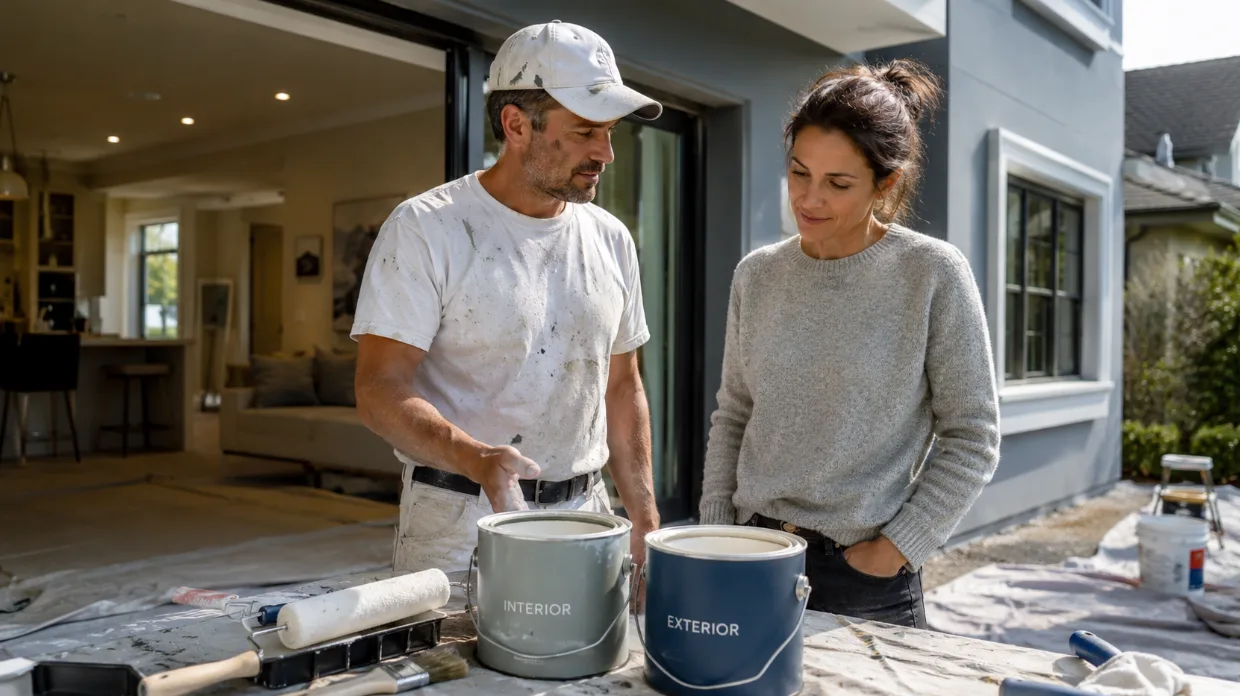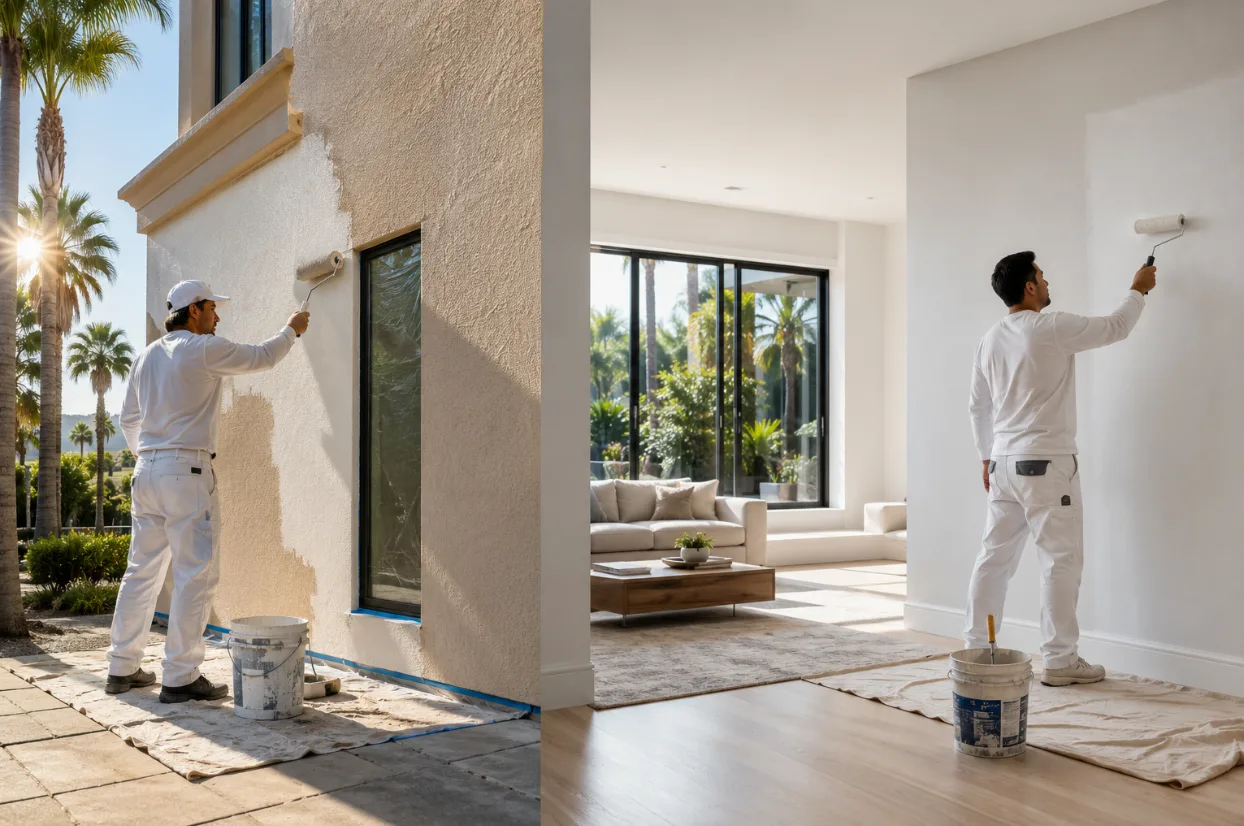
Interior and exterior paint look the same in the can. They are not the same product.
Exterior paint is built to survive weather. It carries UV inhibitors, mildewcides, and flexible binders that stretch with heat and cold. Interior paint is built for the air you breathe — low-VOC, easy to clean, smooth on the wall. Swap one for the other and you get shorter paint life, peeling, or fumes you don’t want in the house.
That difference matters more in Los Angeles than almost anywhere. We get more than 280 days of sun a year, stucco on most homes, and dry Santa Ana winds that beat on every surface. The wrong paint here doesn’t last a decade. It lasts a summer or two.
Here’s exactly what separates the two, why it matters for your home, and how to get it right the first time.
What makes exterior paint different?
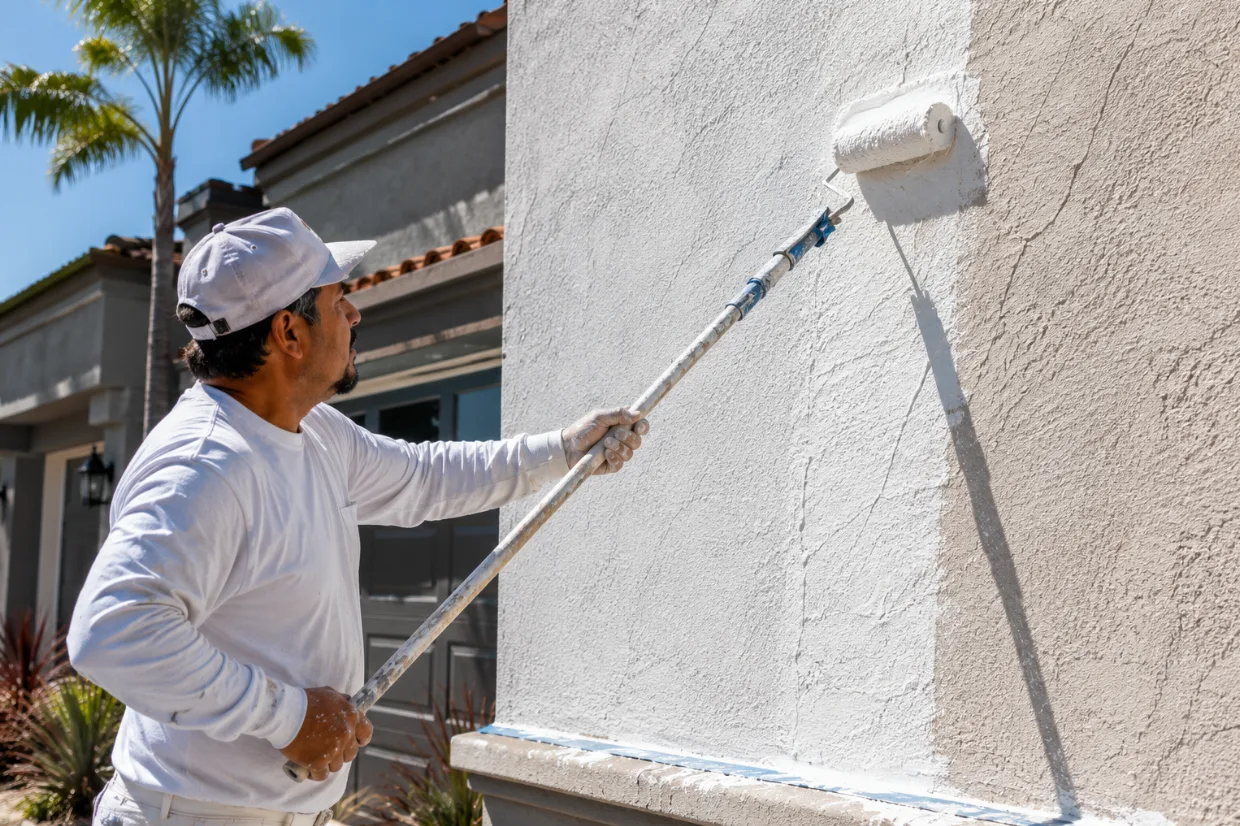
Exterior paint is engineered to take a beating from the outdoors. A few things set it apart.
UV inhibitors. These additives slow fading and chalking from sun exposure. In a city with 280-plus sunny days, that’s the feature that keeps your color from washing out.
Mildewcides. Built-in biocides fight mold, algae, and mildew. They matter in coastal pockets like the Palisades and in shadier Valley yards where moisture lingers.
Flexible binders. Exterior acrylic resins expand and contract as temperatures swing. That flexibility is what stops cracking and peeling when a wall heats up at noon and cools off at night.
Higher VOC levels. Exterior formulas often carry stronger solvents. Outdoors, they off-gas safely into open air. Indoors, that same off-gassing is a problem — more on that below.
Elastomeric options. For stucco, elastomeric coatings go on thick and bridge hairline cracks. On older LA stucco homes, that’s often the right call.
Exterior paint is also thicker. That helps it grip rough surfaces like stucco, brick, and wood siding.
What makes interior paint different?
Interior paint solves a different problem. It doesn’t fight weather. It lives with your family.
Low or zero VOC. Indoor paint is formulated to keep fumes down so the air stays safe for kids, pets, and anyone with sensitive lungs. This is the big one for enclosed spaces.
Easy to clean. Interior finishes are made to be wiped and scrubbed. Fingerprints, scuffs, a toddler’s marker — washable paint handles it.
Better color indoors. Interior pigments are tuned for how color reads under lamps and indirect window light. They look right inside, even if they’d fade fast outside.
Scuff and stain resistance. Hallways, kids’ rooms, kitchens. Interior paint is built to hold up to daily contact, not sun and rain.
Lighter on mildewcide. Most rooms don’t need heavy fungicides, and loading them in can irritate some people. Bathrooms and laundry rooms are the exception, where a little mildew resistance helps.
Interior vs. exterior paint: side-by-side comparison
Here’s the quick version, feature by feature.
| Feature | Interior Paint | Exterior Paint |
|---|---|---|
| VOC level | Low or zero — safe for enclosed rooms | Higher — off-gasses safely outdoors |
| UV resistance | Minimal | High, with UV inhibitors |
| Mildewcide | Light, only where needed | Strong, built in |
| Flexibility | Lower, smooth, stable finish | High — flexes with temperature |
| Pigments | Organic, true indoor color | Synthetic, fade-resistant |
| Best surfaces | Drywall, plaster, trim | Stucco, siding, brick, wood |
| Typical lifespan | 3–4 years on walls | 8+ years outdoors |
| Cost per gallon | Usually lower | Usually higher |
Both are water-based acrylic in most modern lines. The base is similar. The additive package is what changes everything.
Is exterior paint the same as interior paint?
No. Same family, different job.
Modern interior and exterior paints are often both water-based acrylic, so the foundation looks alike. But the additives, binders, and pigments are built for opposite environments. Exterior paint trades indoor air safety for weather protection. Interior paint trades weather protection for low fumes and easy cleaning.
You can’t fairly swap one for the other and expect good results. Each one is missing what the other job needs.
Which paint brands are best for Los Angeles homes?
The best paint for an LA home is whatever matches the surface and the sun load. A few products show up again and again on quality local jobs.
Sherwin-Williams Duration (exterior). A strong pick for LA stucco, with solid UV and moisture resistance.
Benjamin Moore Aura Exterior. A premium option, often used on trim and accent areas where color needs to hold.
Sherwin-Williams Emerald (interior). Low-VOC and highly scrubbable, good for high-traffic rooms.
Elastomeric coatings. For stucco homes with hairline cracks, these thicker coatings seal and protect better than standard paint.
The brand matters less than the match. A great exterior paint on the wrong prep still fails. Green Star Remodeling’s painting team selects the right product for every surface and preps it properly first — backed by 20-plus years of LA work and CA Lic #1088206. If you’d rather skip the guesswork, get a free estimate.
What happens if you use the wrong paint?
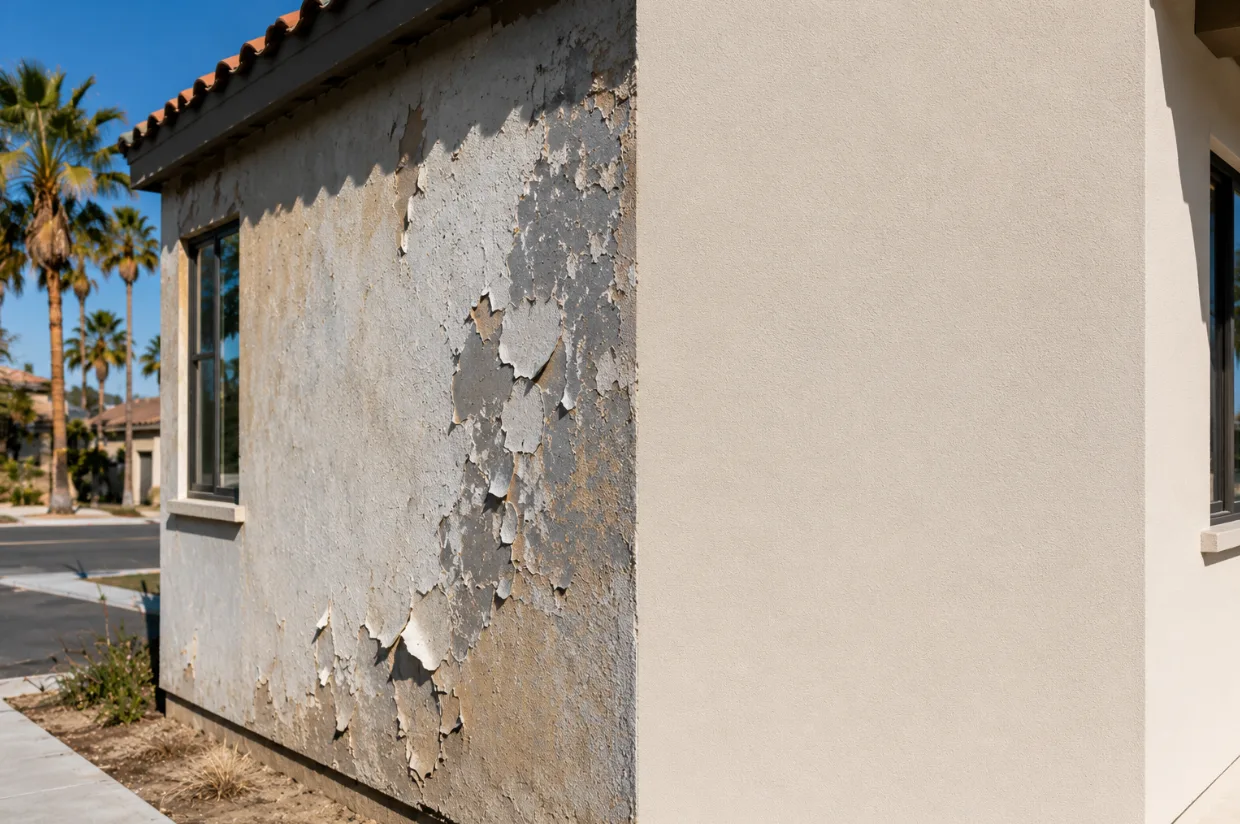
Short answer: you pay for it twice.
Exterior paint inside. Those higher VOCs and stronger additives keep off-gassing in a closed room. Fumes can linger for weeks, sometimes months. The EPA notes indoor VOC levels can run two to five times higher than outdoor levels, and they spike right after painting. The finish can also dry too hard or brittle for indoor walls. Not worth the risk.
Interior paint outside. This fails fast. Without UV inhibitors and flexible binders, interior paint fades, cracks, and peels — often within a few months. In LA sun, it’s even quicker. You’ll be repainting before the next season.
Here’s the LA-specific part. UV degradation runs faster in a high-sun climate, so the wrong product breaks down sooner here than it would in a milder city. Correct paint choice isn’t a nice extra. It’s the difference between a 10-year finish and a 2-year repaint.
The bottom line for LA homeowners
In Calabasas, Sherman Oaks, Tarzana, and across the San Fernando Valley, the high-UV climate makes paint selection and prep non-negotiable. The right product on a well-prepped surface is what separates a finish that lasts ten years from one you redo in two.
Green Star Remodeling’s licensed painting team (CA Lic #1088206) uses the correct paint for every surface, inside and out, with 20-plus years of LA-specific experience behind it. Explore our interior and exterior painting services in Los Angeles, or contact us for a free estimate and we’ll match the right finish to your home.
Frequently Asked Questions
Can you use exterior paint for interior walls?
It’s not recommended. Exterior paint has higher VOCs and stronger additives that off-gas indoors, which hurts air quality and can leave odors for weeks. The finish may also be too brittle for interior walls. Use a low-VOC interior paint instead.
Is exterior paint more durable than interior paint?
Yes, outdoors. Exterior paint is built with UV inhibitors, mildewcides, and flexible binders, so it lasts around 8 years or more on siding and stucco. Interior walls usually need a refresh every 3 to 4 years. Durability only counts in the right setting, though.
Is exterior paint more expensive than interior paint?
Generally, exterior painting projects cost more than interior painting projects. Exterior work typically requires additional surface preparation, weather-resistant coatings, specialized equipment, and more labor to safely access higher areas. Interior painting is often less complex and focuses more on appearance, finish quality, and protection of indoor spaces.
How do you tell if paint is interior or exterior?
Check the can label first — it states the intended use. Beyond that, exterior paint is thicker, lists UV and mildew resistance, and notes higher VOCs. Interior paint highlights low VOCs, washability, and scrub resistance.