A lot of Los Angeles homeowners are sitting on more potential than they realize.
That garage you barely use. The backyard that’s mostly just dead grass. The spare bedroom suite at the end of the hall. Under California law in 2026, any of those could become a legal, rentable, livable unit — without selling your home, without subdividing your lot, and without nearly as much red tape as it used to take.
That’s what an ADU is. And the rules around building one in LA just got significantly more homeowner-friendly.
Three new laws signed by Governor Newsom in October 2025 — SB 543, AB 1154, and AB 462 — shortened permit timelines, cleared up rules that had been confusing for years, and opened doors for homeowners in coastal communities and post-fire rebuilds that were previously closed.
This guide breaks all of it down in plain language. What you can build, how big, what it costs in terms of time, and what the new laws actually mean for your property.
First: What Exactly Is an ADU?
ADU stands for Accessory Dwelling Unit. It’s a self-contained home — its own kitchen, bathroom, entrance — built on the same lot as your existing house. That’s it. The “accessory” part just means it’s secondary to the main home.
There are three types, and the rules for each are a little different.
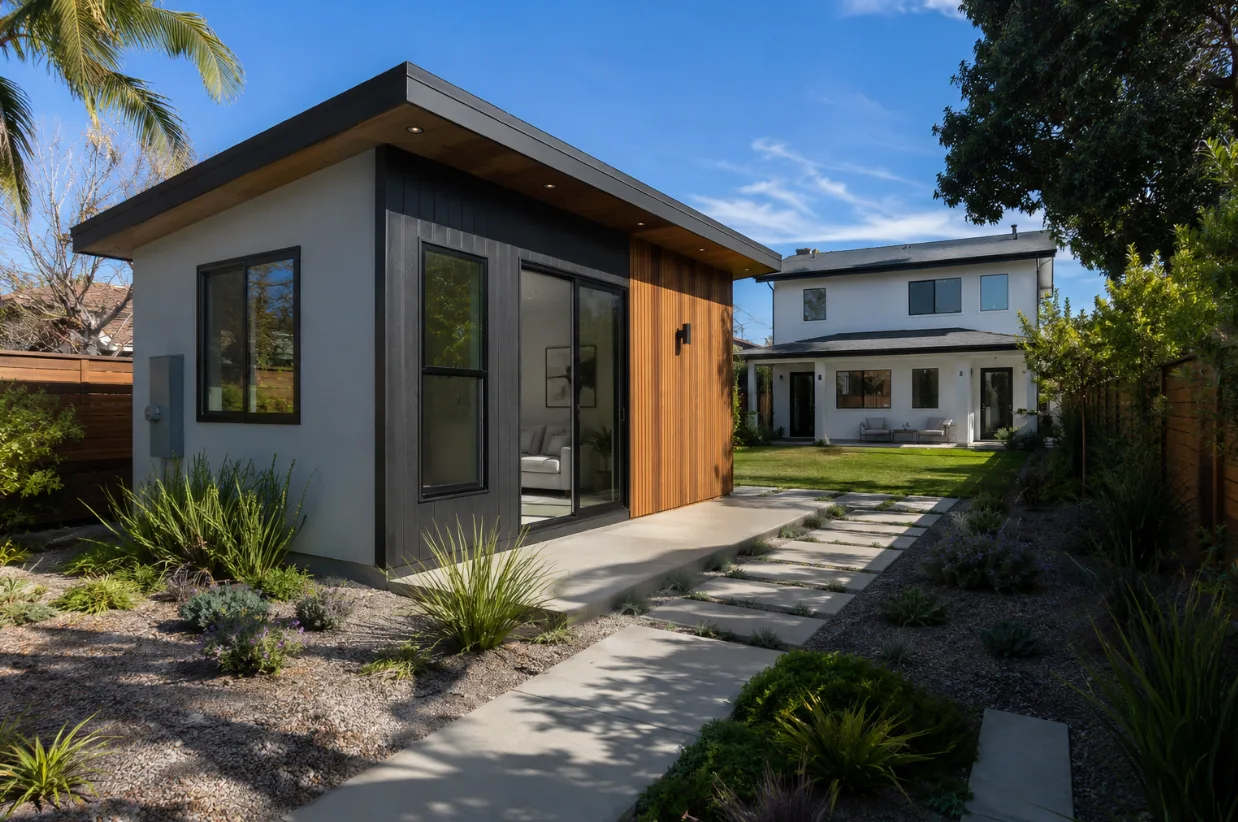
A standard ADU is what most people picture: a backyard cottage, a converted garage, or an addition attached to the house. It’s fully independent — whoever lives there doesn’t share anything with you. Can be rented to anyone, for any length of stay (subject to local rules), without you living on the property.
A JADU (Junior ADU) is smaller — up to 500 square feet — and has to be carved out of your existing home’s footprint. Think: a converted master suite with a small kitchen added and its own separate entrance. A JADU can share a bathroom with the main house, but that choice affects the owner-occupancy rules (more on that in a moment).
A garage conversion is exactly what it sounds like. You take your existing garage and turn it into a livable ADU. No new foundation. No new roof. You’re working with a structure that’s already there, which makes it the fastest and most affordable path for most LA homeowners.
Here’s something that surprises people: you can have all three on one single-family lot. A detached ADU in the backyard, a JADU carved from inside the main house, plus the primary home itself. That’s potentially 1,700+ square feet of additional living space on property you already own.
What Can You Actually Build? Size, Height, and Setbacks in 2026
Here’s the quick reference. All of this is based on California law as updated January 1, 2026.
| ADU Type | Max Size | Height | Setback from Property Line |
|---|---|---|---|
| New detached ADU | 1,200 sq ft | 16 ft (up to 25 ft near transit) | 4 ft side and rear |
| Attached ADU | Up to 50% of your home, max 1,200 sq ft | Same as main home | Same as main home |
| Garage or structure conversion | Whatever the garage already is | Whatever it already is | None required |
| JADU | 500 sq ft | Inside the existing home | None required |
A few things worth knowing that the table doesn’t fully capture:
You can always build at least 800 square feet. Even if your local zoning would technically restrict you to less, state law says cities can’t prevent you from building a minimum of 800 square feet — as long as your ADU meets the 4-foot setback. That’s a hard floor cities can’t go below.
There’s no minimum lot size. California law explicitly prohibits cities from requiring your lot to be a certain size before they’ll approve an ADU. If you own residential property in LA, you’re eligible. Period.
Garage conversions don’t need new setbacks. This one matters a lot. If your garage currently sits 2 feet from the property line, it can become an ADU at 2 feet from the property line. You don’t have to meet the 4-foot rule because you’re not building anything new — you’re converting what’s already there.
Size is now measured as interior livable space. SB 543 clarified this. Square footage counts are based on the space you actually live in — not exterior walls, not stairways, not storage areas. This closed a loophole where different cities were measuring differently and rejecting plans that should have been approved.
What the Three New Laws Actually Mean for You
You don’t need to read the bill text. Here’s what each one does in plain terms.
SB 543 — Cities Can’t Stall Your Application Anymore
Here’s how it used to work: you’d submit your ADU permit application, and the city could take as long as it wanted to decide whether your paperwork was even complete. Weeks. Sometimes months. With no real explanation of what was missing.
SB 543 fixed that. Cities now have 15 business days to review your application and tell you if it’s complete or not. If they miss that deadline, your application is automatically considered complete — no city action required. And if they say something is missing, they have to give you a specific written list. No more vague “come back with more information.”
Once your application is deemed complete, the city has 60 days to approve or deny it. That clock was already in state law — SB 543 just closed the loophole that let cities delay indefinitely before that clock ever started.
This also clarified one more thing homeowners had been confused about: you can combine ADU types on one lot. Detached ADU + garage conversion + JADU, all on the same single-family property. That combination is now explicitly permitted.
AB 1154 — JADU Rules Got Simpler (and Fairer)
Before this law, if you had a JADU on your property, you had to live on-site — either in the main house or in the JADU itself. For homeowners who wanted to rent out both units, that was a dealbreaker.
AB 1154 changed the rule. Here’s how it works now:
If your JADU has its own bathroom — no owner-occupancy required. You can rent both the main house and the JADU without living there.
If your JADU shares a bathroom with the main house — the owner-occupancy rule still applies. Someone in the owner’s family needs to live on the property.
One new restriction came with this: JADUs cannot be used for short-term rentals. If you’re renting a JADU out, it has to be for longer than 30 days. No Airbnb arrangements.
AB 1154 also added a parking rule that’s useful for smaller ADUs: any ADU of 500 square feet or smaller is now exempt from parking requirements — regardless of how close or far it is from public transit. Previously, parking waivers were mainly tied to transit proximity. Now small ADUs get the exemption automatically.
AB 462 — Two Big Wins for Coastal and Fire-Affected Homeowners
This one is especially relevant for LA homeowners in coastal areas and for anyone affected by the 2025 wildfires.
If you’re in a coastal zone (Malibu, Venice, Pacific Palisades, and similar neighborhoods), ADU permits used to require a separate Coastal Development Permit — a process that could drag on for 9 to 18 months, with the possibility of appeals to the California Coastal Commission adding even more time. AB 462 changed this. Coastal ADU permit decisions now have a 60-day deadline. And appeals to the Coastal Commission for those decisions are eliminated.
If your home was damaged or destroyed in a declared disaster — specifically any emergency declaration issued on or after February 1, 2025 — and you have a permitted ADU still standing on the property, you can now get a Certificate of Occupancy for that ADU and move in before the main house is rebuilt. Previously, state law required the main home to have its occupancy certificate first. For families whose primary residence burned in the Palisades or Eaton fires, this provision means they can legally live in their ADU while rebuilding — something that wasn’t possible before.
Who Gives You Permission to Build — City, County, or Someone Else?
This is where a lot of homeowners waste weeks going to the wrong place. Los Angeles is not one permit authority. It’s many.
If your address is within the City of Los Angeles — which includes neighborhoods like Encino, Tarzana, Northridge, Woodland Hills, Sherman Oaks, Reseda, and many others — your ADU permit goes through the Los Angeles Department of Building and Safety (LADBS) at dbs.lacity.gov. LADBS has a pre-approved Standard Plan Program for ADUs. If you choose one of those plans, permits are often approved in 21 to 30 days. Custom designs go through the standard 60-day review.
If your property is in unincorporated LA County — portions of the San Gabriel Valley, parts near the Santa Monica Mountains, and some communities without their own city government — your permit goes through LA County Department of Public Works. Different department, different forms, different process.
If you live in a city within LA County — Calabasas, Burbank, Pasadena, Santa Monica, Culver City, and dozens of others — each has its own planning and building department. State law sets the minimum rules every city must follow, but local fees, design standards, and timelines vary.
The fastest thing you can do right now: confirm your jurisdiction before you do anything else. It determines everything from who you call to how long the process takes.
Do You Have to Live There to Rent an ADU?
Short answer: probably not.
For standard ADUs: No owner-occupancy required. A law that took permanent effect in January 2024 prohibited cities from making you live on the property to rent out an ADU. You can rent the main house and the ADU separately, without living there yourself.
For JADUs: It depends on the bathroom situation, as explained in the AB 1154 section above. Own bathroom = no occupancy requirement. Shared bathroom = you or your family needs to be on-site.
What about short-term rentals? Standard ADUs may be eligible depending on your city’s rules — Los Angeles has its own Home Sharing ordinance that governs this. JADUs cannot be short-term rentals under state law. Any JADU rental must be longer than 30 days.
One thing that doesn’t change regardless of the law: new ADUs are exempt from rent control restrictions under Costa-Hawkins for 30 years from the date of the original Certificate of Occupancy. That matters if you’re building an ADU as a long-term investment — you’re not walking into the same rent increase restrictions that apply to older rental units in LA.
Getting Your ADU Permitted: What the Process Looks Like

People often ask how long this takes. The honest answer: it depends on which path you take, and what your property’s specific conditions are.
Here’s how the process generally works for City of LA properties through LADBS:
Step 1: Figure out what’s feasible on your lot. Lot size, current structures, setbacks, utility connections, fire zone designation — these all affect what you can build and where. A contractor who regularly works in your area will spot the relevant conditions quickly.
Step 2: Choose pre-approved plans or go custom. LADBS has a Standard Plan Program with pre-vetted ADU designs. Choosing one of these compresses your approval timeline significantly — 21 to 30 days in many cases. Custom architectural plans can produce a better fit for your lot but require the full 60-day review after your application is deemed complete.
Step 3: Submit your application. This goes through LADBS’s ePlanLA portal or in person at a Construction Services Center. Under SB 543, the city has 15 business days to tell you if the application is complete. If they don’t respond in time, it’s automatically deemed complete.
Step 4: Plan check. LADBS reviews zoning compliance, building code, and California Title 24 energy requirements. Title 24 applies to all new ADU construction — insulation, high-efficiency lighting, ventilation, and solar-ready conduit in most cases.
Step 5: Permit issued, construction begins. Inspections happen at key milestones: foundation, framing, rough-in plumbing and electrical, and final.
Step 6: Final inspection and Certificate of Occupancy. Once this is issued, the unit is legal and livable.
Realistic timelines: A garage conversion using a pre-approved plan can reach permit approval in 3 to 6 weeks, with total construction completing in 4 to 6 months. A new custom detached ADU typically runs 3 to 5 months for permitting and another 8 to 14 months for construction. These are ranges — your specific property conditions, material choices, and LADBS’s current workload all affect the actual timeline.
Why Most LA Homeowners Start With a Garage Conversion
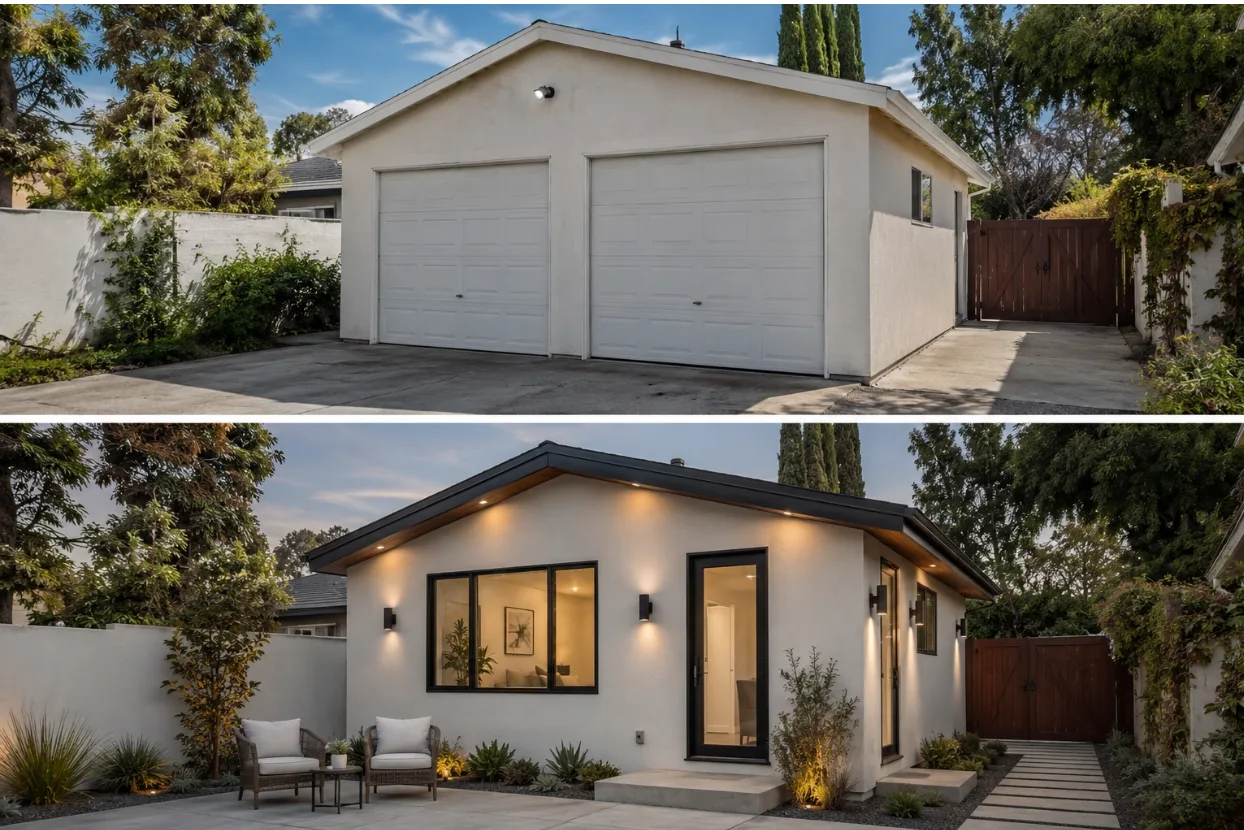
If you have a detached garage you barely use, converting it is almost always the smartest first move. Here’s why.
You skip the most expensive parts of new construction. No new foundation. No new roof. No new framing. You’re working with a structure that already exists — adding insulation, interior walls, flooring, electrical, plumbing, windows, and a proper entrance. That’s a fundamentally different (and cheaper) scope than building from scratch.
The setback issue disappears. Because you’re converting an existing structure rather than building something new, you don’t need to meet the 4-foot setback requirement. Your garage can be right up against the property line and it’s still convertible. This opens up the option for homeowners whose lots would otherwise be too tight for a new detached unit.
Permits move faster. Garage conversions, especially those using LADBS Standard Plans, are clearing plan check faster than almost any other ADU type right now in LA. The structural review is simpler because you’re not introducing new construction into new ground.
The one real limitation: you can’t make it bigger than the garage already is. If the space isn’t large enough for what you need, a new detached ADU or an attached addition may be the better fit. For a deeper walkthrough of this specific path, our garage conversion guide answers the questions LA homeowners ask most.
If your ADU project also means reshaping your yard or outdoor space, Green Star’s landscaping and pools service can handle that work as part of the same project — so you’re not coordinating two separate contractors disrupting your property at different times.
Is an ADU Worth It Financially?
That depends on your goals, but for most LA homeowners the answer leans yes — especially right now.
Rental demand in Los Angeles is strong. A well-built ADU in areas like the San Fernando Valley, West LA, or the Eastside can generate meaningful monthly income. And because new ADU construction is exempt from rent control restrictions for 30 years under Costa-Hawkins, you’re not subject to the same limitations that apply to older rental units in the city.
Beyond rental income, an ADU adds livable square footage to your property — which directly affects assessed value and resale appeal. Multigenerational households are also increasingly common in LA, and an ADU gives adult children or aging parents their own space on the same property without sharing walls with the main home.
The cost varies too much by project type to generalize meaningfully here. For a realistic look at what these projects involve financially in the LA market and how to think about return on investment, our home remodeling value guide covers that in detail.
What we will say: the homeowners who build ADUs and are happiest with the outcome are the ones who planned the project around a clear goal — rental income, housing a family member, or long-term property value — rather than building speculatively and figuring out the use later.
Thinking About Adding an ADU to Your LA Property?
If you’ve been sitting on the idea of an ADU — and especially if you have a garage that’s more storage unit than anything else right now — 2026 is a genuinely good time to move forward. The permit process is faster than it’s been in years. The rules are clearer. And the financial case is strong in the LA market.
Green Star Remodeling has been working with homeowners across Los Angeles for over 20 years. We’re licensed (CA License #1088206), we pull permits correctly under our own license, and we handle the entire process — feasibility assessment, design, permitting, and construction — as one coordinated project. We serve homeowners in Tarzana, Encino, Northridge, Woodland Hills, Calabasas, Sherman Oaks, and throughout the San Fernando Valley.
If you’re also thinking about updating the main home at the same time, our full home remodeling service lets us coordinate both scopes together — which is almost always more efficient than running them as separate projects.
Talk to us about your ADU — schedule a free property consultation
No pressure. We’ll walk your property, tell you what’s realistic, and give you a clear picture of what the project actually involves before you commit to anything.
Frequently Asked Questions
How big can my ADU be in Los Angeles?
A new detached ADU can be up to 1,200 square feet. An attached ADU can be up to half the size of your main home, maxing out at 1,200 square feet. A JADU tops out at 500 square feet. And no matter what local zoning says, state law guarantees you the right to build at least 800 square feet as long as you meet the 4-foot setback requirement.
Does my garage have to be a certain distance from the fence to become an ADU?
No. When you convert an existing structure rather than build something new, California law says no additional setback is required. Your garage can sit right at the property line and still qualify for conversion.
Do I need to live on my property to rent out an ADU?
Not for a standard ADU. California permanently removed that requirement in 2024. For a JADU, it depends: if your JADU has its own bathroom, no owner-occupancy is required. If it shares a bathroom with the main house, someone in your household needs to live on the property.
Will I need to add a parking space for my ADU?
Probably not. Parking is waived if your property is within a half-mile of public transit — which covers most of LA. ADUs of 500 square feet or smaller are now exempt from parking requirements entirely, regardless of transit. And if you’re converting a garage, the city cannot require you to replace the parking spaces you’re removing.
How long will the permit process take?
Using LADBS pre-approved Standard Plans for a garage conversion: typically 3 to 6 weeks for permit approval. Custom-designed new construction: up to 60 days from a complete application, though LADBS must respond on completeness within 15 business days under the new SB 543 rule. Add construction time and total project timelines run 4 to 6 months for garage conversions and 10 to 14 months for new detached ADUs.
Who do I actually call to start the permit process?
That depends on where you live. City of LA properties go through LADBS (dbs.lacity.gov). Unincorporated LA County properties go through LA County Department of Public Works. If you live in an incorporated city like Calabasas or Pasadena, contact that city’s building department directly. Your contractor should know this for your area — it’s one of the first things we confirm for every project.
Disclaimer: This article is for informational purposes only and should not be considered legal, engineering, or professional advice. California ADU laws and local regulations may change over time and can vary by jurisdiction. Always verify current requirements with the appropriate local building department or qualified professional before planning or submitting an ADU permit application.