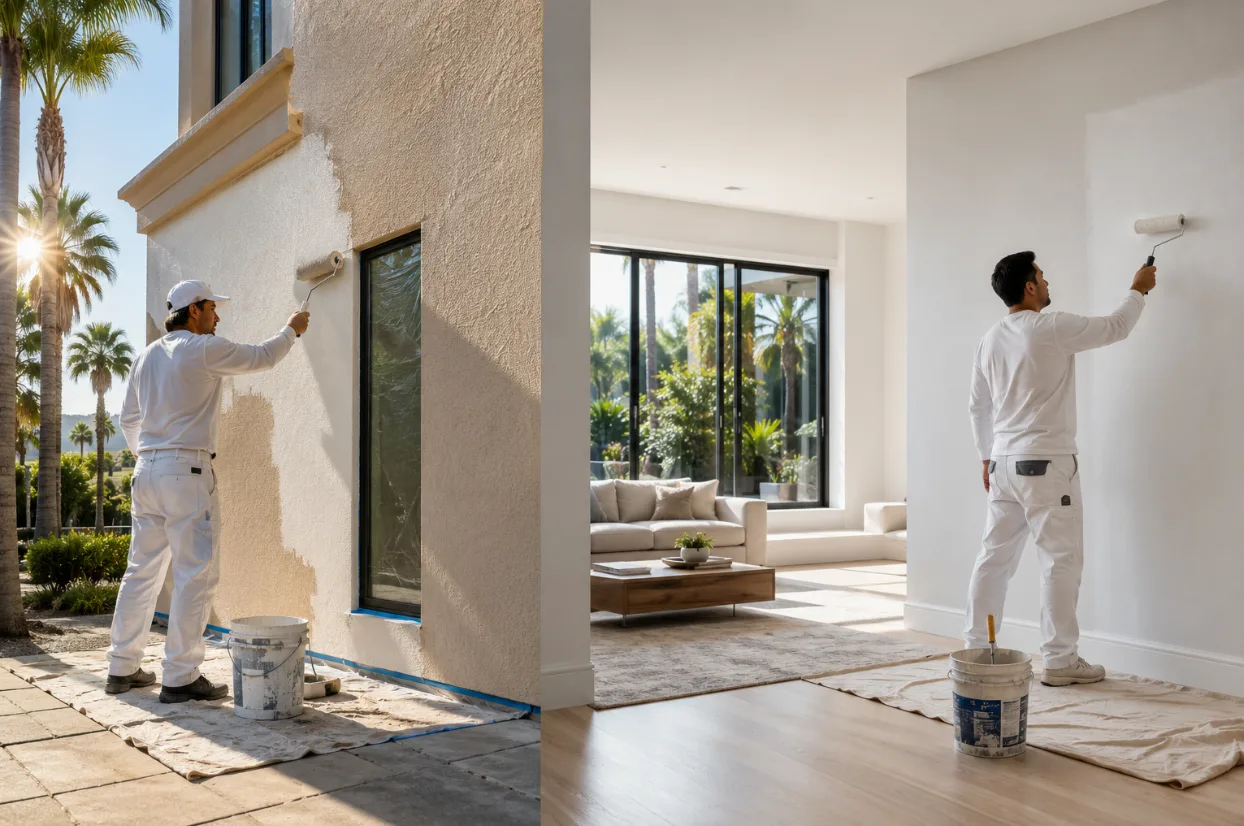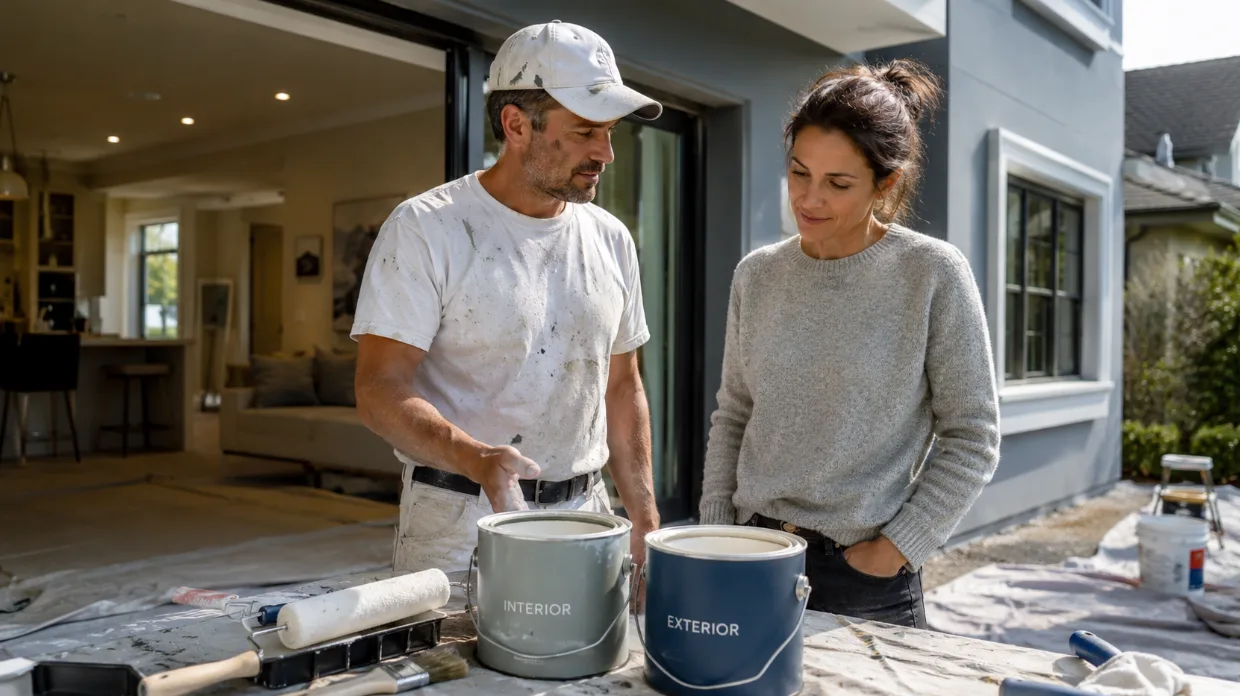
Technically yes for exterior paint inside, but you shouldn’t — and the reverse is even worse. Exterior paint contains higher VOCs and additives like mildewcide and UV blockers designed to off-gas outdoors, not indoors. Using it inside can affect your air quality and won’t give you the washable, scuff-resistant finish interior paint is built for. Interior paint outside fails even faster — it lacks the flexible resins exterior surfaces need and will crack, fade, and peel within a season or two in LA’s UV and heat. A handful of narrow exceptions exist for each direction. We’ll cover them below.
This question comes up constantly in LA (Los Angeles) — usually from someone holding leftover paint after a stucco repaint, or someone trying to save a trip to the store. As a licensed California contractor (CSLB #1088206) with over 20 years of interior and exterior painting work across the San Fernando Valley and surrounding communities, here’s the honest answer.
The short version comes down to a real chemistry difference between the two paint types — covered in full on our interior vs. exterior paint comparison guide.
Can You Use Exterior Paint on Interior Walls?

Yes, it’s physically possible — but it’s not recommended for any room you’ll occupy regularly.
Exterior paint isn’t built for indoor environments. Three things separate it from interior paint, and all three matter once it’s on a wall inside your house.
Higher VOC content. Exterior paints carry higher levels of volatile organic compounds because the formulation is built to off-gas outdoors, where airflow carries those compounds away. Indoors, those VOCs sit in your air. Under SCAQMD Rule 1113, flat interior paints sold in LA County must be 50 grams per liter VOC or less, and non-flat interior paints (eggshell, satin, semi-gloss) must be 150 g/L or less. It’s the strictest paint VOC regulation in the United States. Exterior products are formulated differently — meeting their own category limits, but not built for sealed interior spaces.
Wrong finish for indoor wear. Interior paint is built to be scrubbed. It resists scuffs, handprints, kitchen splatter, and cleaning chemicals. Exterior paint is built to resist rain, UV, and mildew — not weekly wiping. Wash an exterior-painted wall a few times and the finish breaks down faster than you’d expect.
Mildewcide and biocides. Exterior paint contains mildewcide additives to fight outdoor moisture. Indoors, those additives are unnecessary — and you’re now breathing them in a closed space.
Sheen looks different indoors. Exterior paint also tends to read differently under artificial light than it does outside in daylight. That “perfect color” from the can may not look right in your living room.
If you’ve already used exterior paint inside, the fix is straightforward — clean, prime, and recoat with interior paint. Full steps in the section below.
Can You Use Interior Paint on Exterior Surfaces?
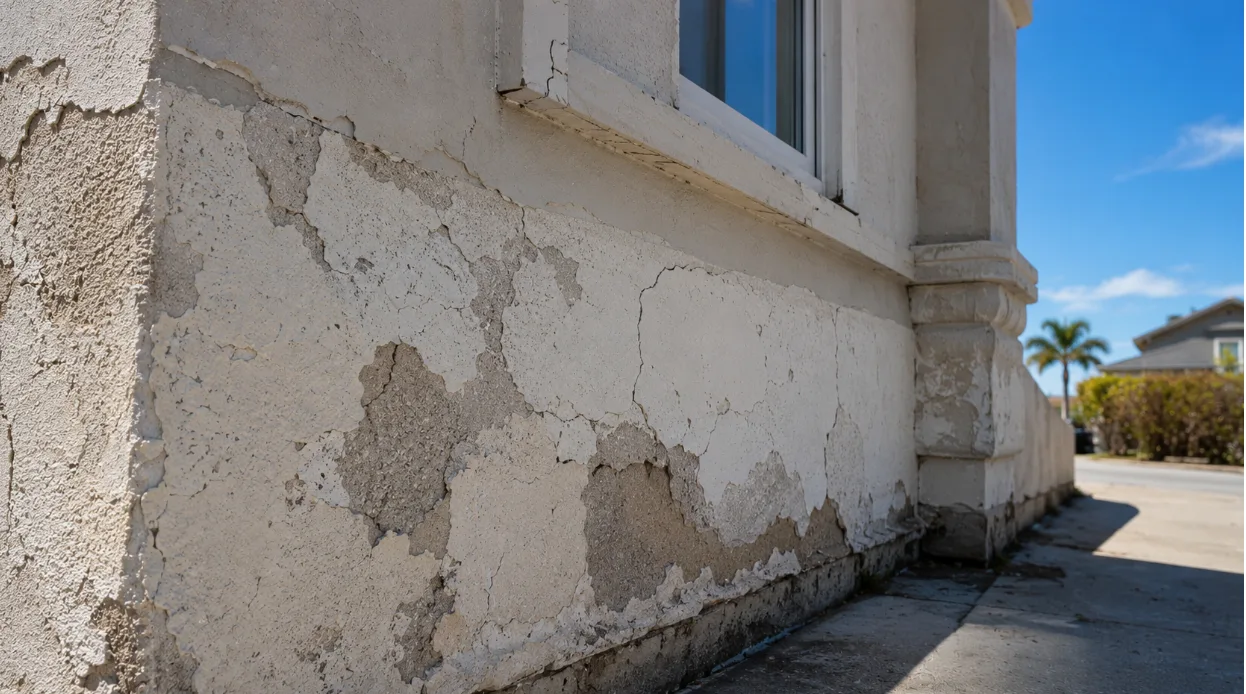
No. This direction has a much clearer “don’t” than the reverse.
Interior paint isn’t built to survive outside, and in Los Angeles it fails fast. Three reasons:
Rigid resins crack with temperature swings. Exterior paint uses flexible resins that expand and contract with the surface underneath. Interior paint uses rigid resins built for stable indoor temperatures. LA’s daily and seasonal swings — cool mornings, hot afternoons, occasional cold snaps — push interior paint past what it can handle. The result is hairline cracking that opens into peeling within one to two seasons.
No UV blockers. Exterior paint contains UV blockers that protect the binder and pigment from breaking down in sunlight. Interior paint doesn’t. In LA’s UV exposure, the color fades and chalks visibly within months.
No mildew resistance. Exterior paint contains mildewcide for damp surfaces. Interior paint doesn’t. In coastal and marine-layer zones — Malibu, Pacific Palisades, parts of Santa Monica — interior paint outdoors will host mildew within the first wet season.
Stucco makes it worse. Stucco moves and develops hairline cracks naturally. Common stucco-clad neighborhoods like Tarzana, Calabasas, Encino, and Woodland Hills depend on flexible exterior paint to bridge those movements. Interior paint can’t, so it cracks along every stucco joint. The same problem hits hillside homes in Sherman Oaks and Studio City, where sun exposure is heaviest and resin flexibility matters most.
Interior paint on an exterior wall in LA usually means repainting the whole exterior again within a year.
Why Are Interior and Exterior Paint Formulated Differently?
Interior and exterior paint differ in three core components: resin, additives, and VOC content. Each is engineered for a specific environment.
Resin (the binder). Interior paint uses harder, more rigid resins for scrub resistance. Exterior paint uses softer, flexible resins to handle thermal expansion and substrate movement.
Additives. Exterior paint contains mildewcide, UV stabilizers, and surfactants for outdoor exposure. Interior paint contains stain blockers and burnish-resistant compounds for indoor wear.
VOC levels. Indoor air quality regulations like California’s SCAQMD Rule 1113 set strict ceilings on interior paint VOCs. Exterior paints sit in different regulatory categories with different limits.
We cover the full chemistry, label-reading, and product-selection side of this question on our interior vs. exterior paint comparison guide.
Are There Any Exceptions Where It’s Actually Okay?
A few narrow exceptions exist — and they all involve transitional or semi-conditioned spaces.
Detached garages, sheds, and covered patios. These spaces have direct outdoor exposure even when “indoor.” Exterior paint is often the correct choice here, especially in LA’s hot Valley summers where garages reach 100°F+. Common garage neighborhoods like Encino, Northridge, Chatsworth, and Woodland Hills see this question often. We’ll cover the full garage answer in a dedicated guide soon.
Mudrooms and laundry rooms with direct outdoor access. These edge cases sometimes justify exterior or hybrid products, especially where humidity and temperature swings affect the room.
Well-ventilated unoccupied storage spaces that can off-gas for weeks before regular use.
A note on primer. Some homeowners ask whether they can use interior primer under exterior paint. Generally, no. Primer-and-topcoat compatibility matters. Use an exterior-rated primer under exterior paint so the flexibility, adhesion, and weather resistance match. Mixing categories defeats the point of using exterior paint at all.
What Should You Do if You Already Used the Wrong Paint?
You don’t usually need to strip it. Clean the surface, lightly sand or deglaze to break the existing finish’s surface, prime with a bonding primer, and recoat with the correct paint type.
The exact fix differs by direction.
If you used exterior paint inside:
- Clean the wall to remove dust and contaminants.
- Lightly sand to dull the existing finish.
- Apply a bonding interior primer.
- Recoat with interior paint matched to the room (flat for ceilings, eggshell or satin for living areas, semi-gloss for trim and wet areas).
- Ventilate well during and after — the original exterior paint may still be off-gassing.
If you used interior paint outside:
- Inspect for cracking, peeling, or chalking. If any of that is present, scrape and sand back to a sound surface.
- Wash thoroughly to remove chalking residue.
- Apply an exterior-rated bonding primer.
- Recoat with quality exterior paint formulated for the substrate (stucco, wood siding, or trim).
- If peeling has reached bare substrate, the underlying material may need spot priming or sealing first.
Honestly, if the exterior repaint involves multiple walls or a full home, the simpler path is hiring a contractor — and confirming up front that they’re using true exterior-rated product. This is one of the easiest places for an unlicensed crew to cut corners.
Local Considerations for Los Angeles Homes
LA’s climate, housing types, and local regulations all affect this decision. Here’s how the major factors break down:
| LA Area / Condition | What It Means for Paint Choice |
|---|---|
| Stucco homes (Tarzana, Calabasas, Encino, Woodland Hills) | Stucco needs flexible, crack-bridging exterior resin. Interior drywall doesn’t — which is exactly why the two paints aren’t interchangeable. |
| Hillside / high-UV exposure (Sherman Oaks, Studio City) | Exterior paint’s UV blockers are wasted indoors and essential outdoors. Interior paint outside fails fastest in this exposure. |
| Coastal / marine layer (Malibu, Pacific Palisades, parts of Santa Monica) | Salt air and humidity reward exterior paint’s mildewcide outside. That same additive is the main reason not to bring it inside. |
| Attached garages (Encino, Northridge, Chatsworth, Woodland Hills) | The most common gray-area space — exterior paint is often correct, but the answer depends on whether the garage is conditioned. |
| California VOC regulations (SCAQMD Rule 1113) | LA County has the strictest paint VOC limits in the U.S. One more reason to use the paint actually formulated and labeled for its intended environment. |
If you’re not sure which exposure type your home faces, a quick walk-through with a licensed contractor usually settles the question in minutes. Our team covers the San Fernando Valley and surrounding LA communities — including Encino, Tarzana, and Calabasas — and can advise based on what your specific home actually needs.
Conclusion
Technically possible in both directions. Not advisable in either. Narrow exceptions exist for transitional spaces, but for occupied rooms or weather-exposed walls, use the paint actually formulated for the job.
If you’re not sure which paint your last contractor used, or you’re planning an interior or exterior repaint and want it done with the right product the first time, we’re happy to take a look.
Get a free estimate for your project — explore our Los Angeles interior and exterior painting services, or contact us to learn more about how we work. CA Lic #1088206 · 20+ years across the San Fernando Valley and surrounding LA communities.
Frequently Asked Questions
Is it okay to use exterior paint on interior walls?
Technically yes, but it’s not recommended. Exterior paint has higher VOCs and additives like mildewcide that off-gas best outdoors, not inside enclosed rooms. It also lacks interior paint’s scrub resistance, so it won’t hold up to washing and cleaning. Use interior paint for any occupied indoor space.
Can you use exterior paint on interior doors or trim?
You can, but the same problems apply — higher VOCs, lower scrub resistance, and a finish not designed for daily handling. Interior trim paint is built to handle fingerprints, cleaning, and contact wear. Use the right product, especially on high-touch doors and trim.
Can you use interior paint on an exterior door?
No. Even one door exposed to LA’s UV, heat, and rain will chalk, fade, and crack within a season or two. Exterior doors need exterior-rated paint with UV blockers and flexible resins. Interior paint on an exterior door is one of the fastest failures you’ll see.
Can you use interior primer under exterior paint?
Generally no. Primer and topcoat should be matched to the same environment. Interior primer lacks the flexibility, adhesion strength, and weather resistance that exterior topcoats depend on. Use an exterior-rated primer for any outdoor application.
What happens if you accidentally use interior paint outside?
Expect cracking, peeling, chalking, and visible fading within one to two LA seasons. Stucco surfaces show damage fastest because of natural movement. Coastal exposure adds mildew on top of UV damage. The fix is scraping the failed paint, priming with an exterior-rated primer, and recoating with exterior paint.
Do you have to strip exterior paint off interior walls before repainting?
No. Clean the wall, lightly sand or deglaze the surface, apply a bonding interior primer, and recoat with interior paint. Stripping is only needed if the exterior paint is peeling, blistering, or otherwise failing — which is uncommon indoors.