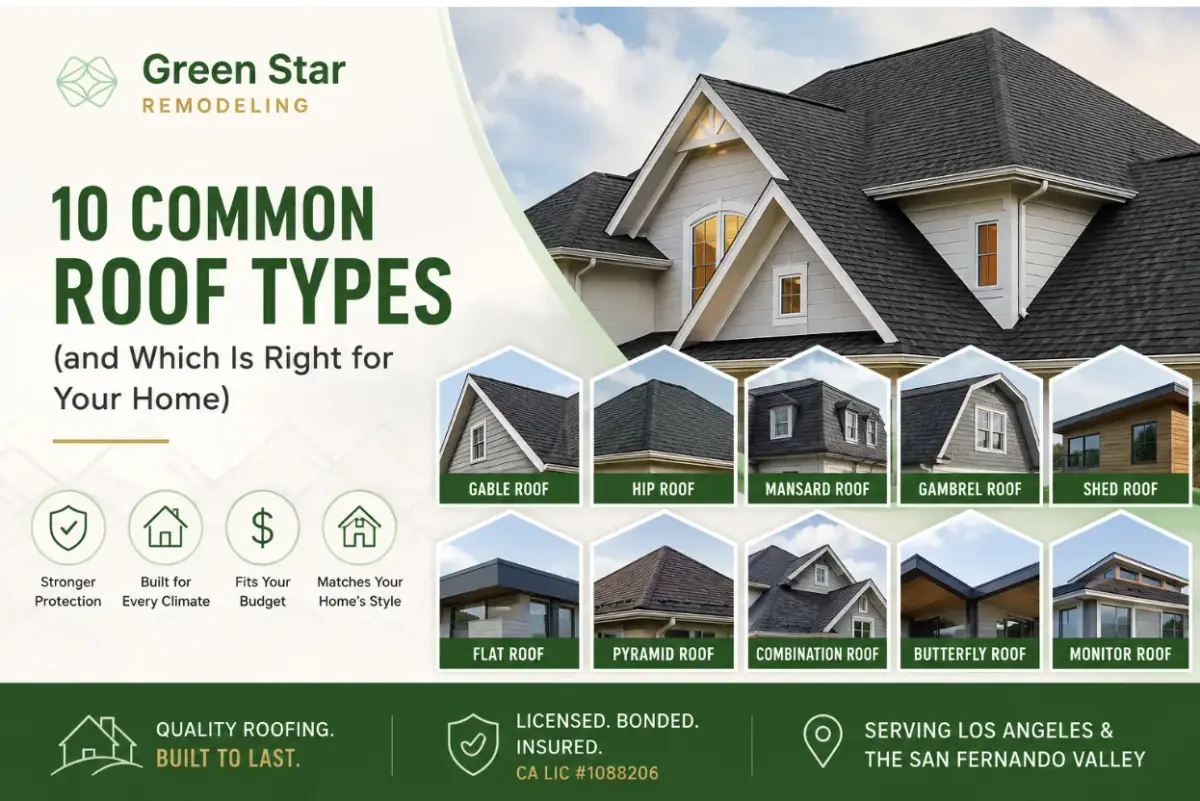
The shape of your roof does more than set your home’s look. It decides how well your roof handles wind, rain, and sun, how much it costs to build, and how long it lasts. Whether you’re planning a new build, an addition, or a full replacement, the roof type is one of the first big choices you’ll make.
This guide walks through the ten most common roof types in plain terms: what each one looks like, how it performs, and where it fits best. One quick note before we start: a roof’s pitch is how steep it is, written as a ratio like 6:12 (a rise of 6 inches for every 12 inches across). Steeper roofs shed water faster; flatter roofs cost less but need more care.
What is a gable roof?
A gable roof is the classic shape most people picture: two sloping sides that meet at a ridge and form a triangle at each end. It’s the most common roof in the country, and for good reason.
Gable roofs shed rain and snow easily because of their steep slope. They leave room for an attic or vaulted ceilings, allow good airflow, and use a simple frame that keeps building costs low.
Their one weakness is wind. The flat triangle end can catch strong gusts and lift the roof, so in windy areas they need extra bracing. The triangle wall itself is called the “gable,” and that’s where the name comes from.
Best for: most homes, and areas with rain or snow.
What is a hip roof?
A hip roof has four sloping sides that meet at the top, with no flat triangle ends. All four sides slope down toward the walls, which gives it a balanced, stable look from every angle.
That shape is the hip roof’s biggest strength. With no flat end to catch the wind, it holds up far better in storms, making it a favorite in windy and coastal areas.
The trade-offs are cost and space. A hip roof uses more material and labor, so it runs noticeably more than a gable, and its sloped sides leave a bit less attic room.
Best for: windy and coastal areas, and homes where a balanced look matters.
What is a mansard roof?
A mansard roof, also called a French roof, has four sides, and each side has two slopes: a steep lower slope and a much flatter upper slope. From the street, you often see only the steep part.
The big draw is space. That steep lower slope creates a full extra floor of living space under the roof, sometimes called a garret. Homeowners who may want to add a level later love this flexibility.
The downsides are cost and upkeep. A mansard’s detailed framing takes real skill, so it’s among the priciest shapes. Its near-flat top also holds water and debris, so drainage and maintenance matter.
Best for: homeowners who want maximum living space or a formal, elegant look.
What is a gambrel roof?
A gambrel roof, the classic barn shape, has two slopes on each side: a gentle slope near the ridge and a steep slope below. Think of it as half of a mansard.
That steep lower slope opens up a roomy attic or loft, which is why gambrels are popular on barns, sheds, and Dutch Colonial homes. They use few beams, so they stay affordable to build.
The catch is weather. A gambrel doesn’t handle high wind or heavy snow well; its open shape can strain under hard pressure. It fits calm, mild climates best.
Best for: barns, lofts, and Colonial-style homes in mild climates.
What are shed and flat roofs?
These two modern shapes are worth grouping together. A shed roof is a single slope running from a high wall down to a low wall. A flat roof looks level but has a slight tilt so water can drain.
A shed roof is the simplest of all. Every rafter is the same, so it’s fast and cheap to build. It suits home additions, garages, and ADUs, and a tall shed wall makes room for big windows and lots of light.
A flat roof gives you usable space up top: a deck, a garden, or a spot for solar panels. It’s economical to build, but water drains slowly, so it needs a strong waterproof membrane and regular checks.
Best for: modern homes, additions, ADUs, and rooftop or solar use.
How the main roof types compare
The right roof balances climate, budget, and style. Here’s a side-by-side look at the six main shapes.
| Roof type | Wind resistance | Sheds snow/rain | Relative cost | Best for |
|---|---|---|---|---|
| Gable | Lower (needs bracing) | High | Low | Most homes, wet/snowy areas |
| Hip | High | Medium | Higher | Wind and coastal areas |
| Mansard | Lower | Low | Highest | Adding a top floor, formal look |
| Gambrel | Lower | Low | Low | Barns, lofts, Colonial homes |
| Shed | Medium | High | Low | Modern homes, additions, ADUs |
| Flat | Medium | Low | Low | Rooftop use, solar, modern homes |
Choosing a style based on climate and budget
The smartest order is simple: match the shape to your climate first, then your budget, then your home’s style. That keeps your home protected and your costs in check.
Start with weather. Windy or coastal homes do best with a hip roof. Snowy regions want a steep gable or hip that sheds snow fast. Here in Los Angeles, snow isn’t the concern; sun, heat, Santa Ana winds, and fire risk are. A home in a windy LA canyon is safer with a hip roof than a gable.
Los Angeles homes also have their own style traditions. Spanish and Mediterranean homes use low hip or gable roofs with clay tile, which handles LA sun well and can last over 50 years. Mid-century and modern homes lean toward flat and shed roofs.
Then weigh budget. Simple shapes cost less; gable and shed roofs are the most affordable because their framing is straightforward. Complex shapes like mansard cost the most.
| Climate | Best roof types | Why |
|---|---|---|
| High wind / coastal | Hip | No flat end for wind to lift |
| Heavy snow | Steep gable, hip | Steep pitch sheds snow fast |
| Hot and sunny (like LA) | Low hip, flat, shed | Fits tile and modern styles, sheds sun |
| Dry, low rain | Flat, shed | Low pitch works with little rainfall |
If a replacement is what’s driving your research, the roof’s shape also shapes your material and permit needs. Our guide on when to repair or replace your roof helps you decide, and our step-by-step roof replacement guide shows what the project looks like.
Not sure which roof style fits your home?
The right shape protects your home for decades, so it’s worth getting expert eyes on it. A licensed roofer can weigh your home, your climate, and your budget, then recommend the best fit. Green Star Remodeling is a licensed, bonded, and insured Los Angeles contractor (CA Lic #1088206). Our roofing services cover new roofs, replacements, and repairs across the San Fernando Valley.
Ask a roofer, book a free consultation →
Frequently Asked Questions
What is the most common roof type?
The gable roof is the most common type in the United States. It has two sloping sides that meet at a ridge and form a triangle at each end. Builders favor it because it sheds rain and snow well, allows attic space, and costs less than more complex shapes.
What’s the difference between a gable and a hip roof?
A gable roof has two sloping sides and flat triangle ends. A hip roof has four sloping sides and no flat ends. Hip roofs resist wind better and cost more to build, while gable roofs are cheaper and shed snow well. In windy areas, hip roofs are the safer choice.
What is a mansard roof?
A mansard, or French roof, has four sides with two slopes each, a steep lower slope and a flatter upper slope. The steep part creates a full floor of living space under the roof. It’s elegant and space-efficient but costs more and needs good drainage on its near-flat top.
Which roof type is best for high wind?
A hip roof is best for high wind. With four sloping sides and no flat end for wind to lift, it stays stable in storms. That makes it a strong choice for coastal areas and windy spots like some Los Angeles canyons, where a gable would need extra bracing.
What is the cheapest roof type to build?
Gable and shed roofs are the most affordable to build. Both use simple framing with fewer parts and less labor. A shed roof uses identical rafters, and a gable uses a basic triangle frame, which keeps material and labor costs down.