Cabinets are the most visible part of your kitchen and usually the biggest line in the budget. So the choice deserves a clear framework. The trick is to understand that you’re really making three separate decisions, not one:
- Door style — the look (shaker, flat/slab, raised panel, inset, or glass)
- Box construction — framed or frameless (this controls storage and fit)
- Buying tier — stock, semi-custom, or custom (this controls options, lead time, and price)
A lot of guides blur these together. They’re independent. You can put a shaker door on a frameless box, or order a slab door at any tier. Once you see them as three choices, picking the right cabinets gets a lot easier. This guide walks through each one, plus the hardware that makes cabinets a joy to use.
Cabinet door styles explained
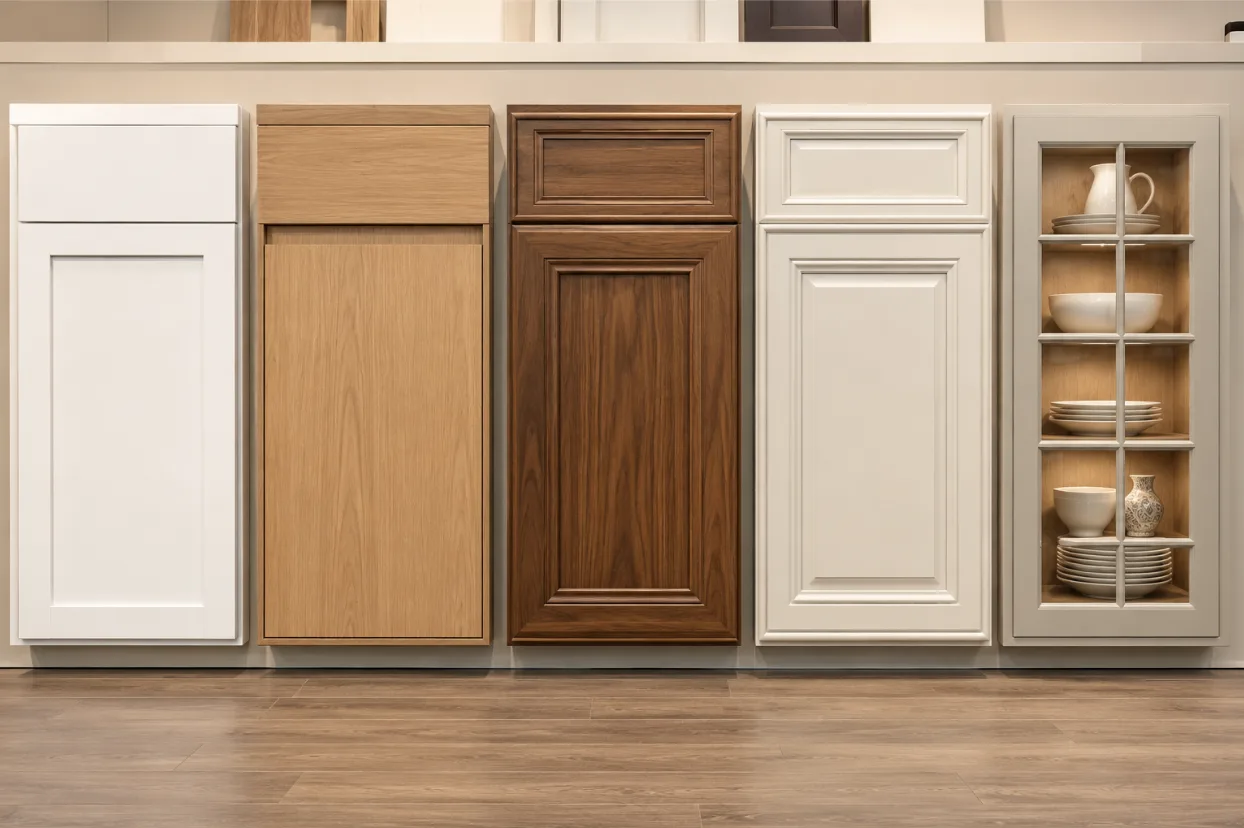
The door is the face of your kitchen. Here are the styles worth knowing.
Shaker. A five-piece door a flat, recessed center panel inside a simple square frame. It has been the most popular style in North America for nearly two decades, and for good reason: it works in almost any kitchen, from modern to farmhouse. Paint it white for clean and classic, or stain it for warmth. Mid-range in price.
Flat panel (slab). A single, smooth, frameless surface with no detailing. This is the look of modern and minimalist kitchens. It’s easy to wipe clean and lets the material like walnut or white oak be the star. Basic slab doors are often the most affordable option, though high-gloss or premium-wood slabs can climb to the top of the range.
Raised panel. A five-piece door with a raised, profiled center panel. It’s the hallmark of traditional and formal kitchens, with more depth and detail. The extra labor makes it the most expensive of the everyday styles.
Inset. The door sits flush inside the cabinet frame instead of over it, for a tailored, furniture-like look. Inset is a premium choice it demands tight tolerances and precise craftsmanship, which is why it’s one of the costlier doors you can buy.
Glass (mullion). A glass panel inside a frame, used as an accent on a few upper cabinets to display dishware and break up a wall of doors. Choose clear, frosted, or textured glass.
| Door style | Look | Relative cost | Best for |
|---|---|---|---|
| Shaker | Clean, classic, versatile | Mid-range | Almost any kitchen |
| Flat / slab | Sleek, modern, minimalist | Low to high (by material) | Modern, contemporary |
| Raised panel | Traditional, formal | Higher | Classic, traditional |
| Inset | Tailored, furniture-like | Premium | Craftsman, high-end traditional |
| Glass / mullion | Open, decorative | Premium accent | Display uppers, accents |
Framed vs. frameless construction
This is the decision most homeowners have never heard of and it matters more than the door style for how your kitchen works. It’s about the cabinet box, not the door.
Framed (American style). A solid hardwood face frame is attached to the front of the box, like a picture frame around the opening. That frame adds rigidity, gives hinges a solid anchor, and important in older LA homes hides minor gaps where cabinets meet uneven walls. Framed boxes support every door overlay: full overlay, partial overlay, and inset. They still hold the majority of the U.S. market.
Frameless (European / full-access). No face frame the doors attach directly to the sides of the box. This gives you roughly 10–15% more usable storage, wider drawers, and a clean, modern wall of doors with thin reveals. The trade-off: frameless demands precise installation on plumb, level walls, so the craftsmanship of your installer matters more.
| Feature | Framed | Frameless |
|---|---|---|
| Face frame | Yes (hardwood) | None (full-access) |
| Look | Traditional / transitional | Modern / European |
| Storage & drawer width | Slightly less | ~10–15% more |
| Door overlays | Full, partial, or inset | Full overlay only |
| Best for | Older homes, classic style | Modern kitchens, max storage |
A quick note on overlays: full overlay doors cover almost the whole box (modern look), partial overlay leaves frame visible between doors (budget-friendly), and inset sits flush inside the frame (premium). Frameless cabinets are always full overlay.
And a word on materials. Cabinet boxes are usually built from plywood (the durable choice in quality work) or particleboard (common in stock lines). Doors come in solid wood, MDF, or a veneer over an engineered core. MDF takes a painted finish beautifully and resists warping, while solid wood shows natural grain and suits a stained finish. The material you pick affects durability and price as much as the door style does.
Stock vs. semi-custom vs. custom
This third decision sets your options, your timeline, and a big part of your price.
Stock. Pre-made in standard sizes (usually 3-inch increments), with a limited set of styles and finishes. It’s the fastest and most affordable route what you’ll find at big-box stores. Great for simple layouts and tight budgets, but you work around the sizes you’re given.
Semi-custom. Standard cabinets with room to modify more sizes, finishes, materials, and door styles. This tier is the sweet spot for most LA kitchens, balancing choice and cost, and it’s the most popular category in the market.
Custom. Built to your exact specifications any size, material, finish, or detail. Custom shines when your kitchen has unusual dimensions, angled walls, or you want a specific look top to bottom. It carries the longest lead time and the highest cost.
| Tier | Options | Lead time | Best for |
|---|---|---|---|
| Stock | Limited | Shortest | Simple layouts, tight budgets |
| Semi-custom | Broad | Moderate | Most kitchens |
| Custom | Unlimited | Longest | Unique layouts, high-end |
Curious why cabinetry drives so much of a remodel’s price? See why a kitchen remodel costs what it does.
Hardware and storage that make cabinets work
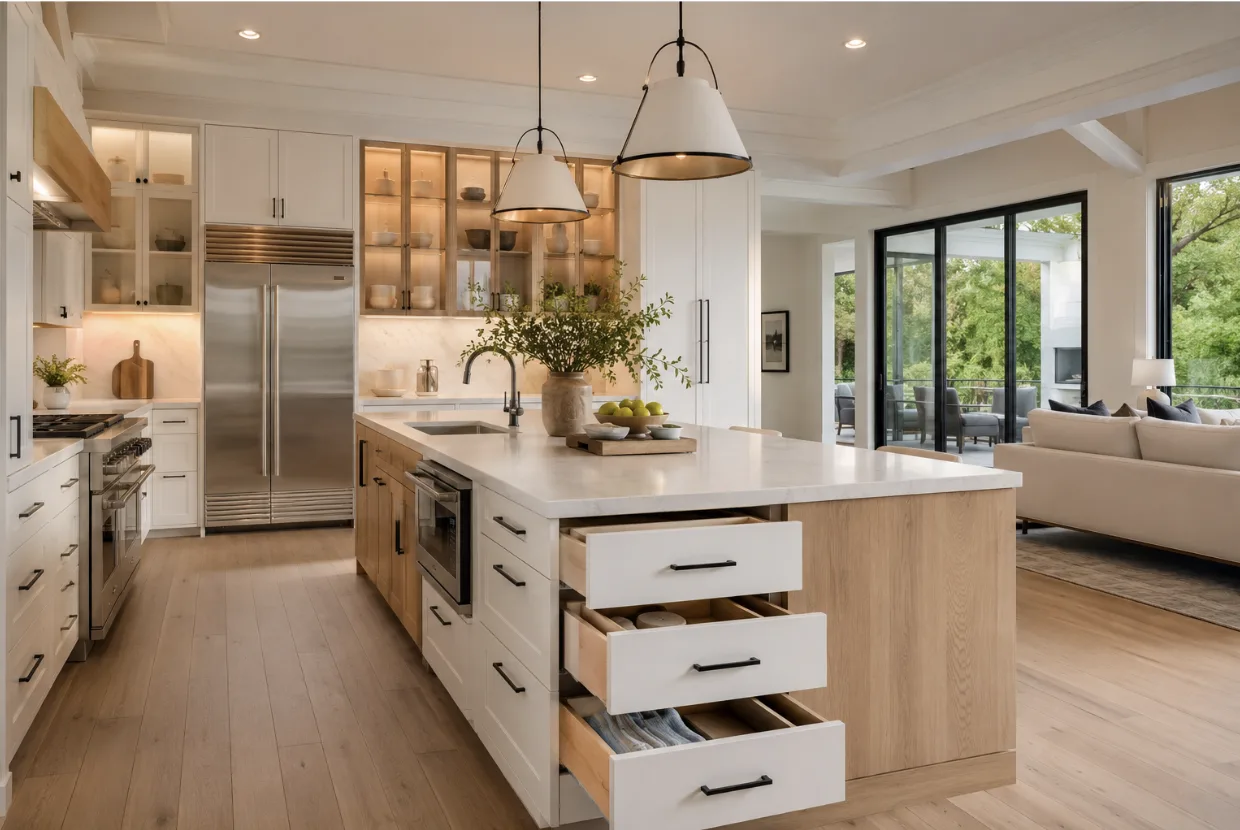
The style sells the kitchen; the hardware is what you feel every day. This is where good cabinetry separates itself.
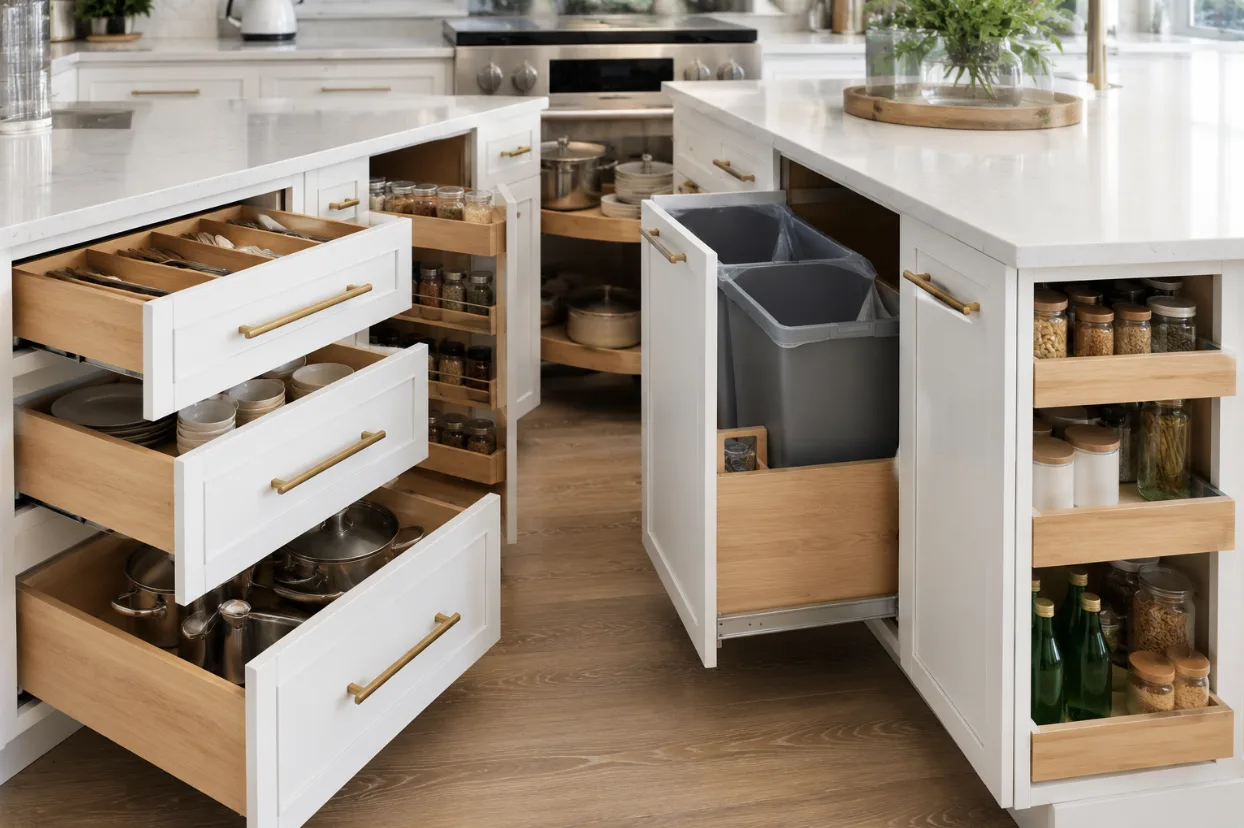
Soft-close hinges and drawer slides are now the standard for quality cabinets. Blum is the leading name here its Blumotion soft-close hinges and drawer systems close silently and last for years.
Pull-outs and organizers turn dead space into usable storage. Rev-A-Shelf makes the pull-out trays, lazy Susans, spice racks, and trash/recycling pull-outs that most homeowners love most. Häfele and Blum offer drawer organization and lift-up systems for upper cabinets.
Full-extension drawers let you reach the very back, and deep drawer boxes (a frameless strength) hold pots and small appliances better than door cabinets.
When you’re planning, decide storage before you finalize the cabinet order the right pull-outs and drawer configuration change which cabinets you need. Our kitchen layout and design guide covers how to plan storage zones around how you actually cook.
Matching cabinet style to your kitchen
Pull it together by starting from the look you want:
- Modern / contemporary → flat slab doors, frameless construction, full-overlay, integrated or minimal hardware
- Transitional (the most common LA choice) → shaker doors, framed or frameless, mixed metals
- Traditional / classic → raised panel or inset doors, framed construction, decorative hardware
- Farmhouse / coastal → white or soft-color shaker, framed, with glass accent uppers
- Older LA home with uneven walls → framed construction, since the face frame hides imperfections
And remember you can mix: many kitchens pair shaker perimeter cabinets with a slab or contrasting-color island, or add a couple of glass uppers for display. Coordinate your cabinet finish with your countertop choice our guide to quartz, granite, marble, and quartzite countertops helps you pair them well.
Design your cabinets with a pro
The best cabinets come from matching door style, construction, tier, and hardware to how you live and to your home. Green Star Remodeling is a licensed, bonded, and insured Los Angeles contractor (CA Lic #1088206). We design and install custom and semi-custom cabinetry with Blum soft-close hardware and Rev-A-Shelf storage for kitchens across the San Fernando Valley.
Book a free design consultation →
Frequently Asked Questions
What is the most popular kitchen cabinet style?
Shaker is the most popular style in North America and has been for nearly two decades. Its simple recessed-panel door works in almost any kitchen modern, transitional, farmhouse, or traditional which makes it a safe, resale-friendly choice.
What’s the difference between framed and frameless cabinets?
Framed cabinets have a hardwood face frame on the front of the box; frameless (European) cabinets don’t. Frameless gives about 10–15% more usable storage and a cleaner modern look, while framed is sturdier on uneven walls and supports inset doors.
Is shaker the same as framed cabinets?
No and this is a common mix-up. Shaker is a door style; framed and frameless describe the box construction. You can have shaker doors on either a framed or a frameless cabinet. They are two separate decisions.
Are custom or semi-custom cabinets better?
Semi-custom suits most kitchens, balancing options and cost with a moderate lead time. Custom is worth it when you have unusual dimensions, angled walls, or want a fully specific look. Stock is best for simple layouts and tight budgets.